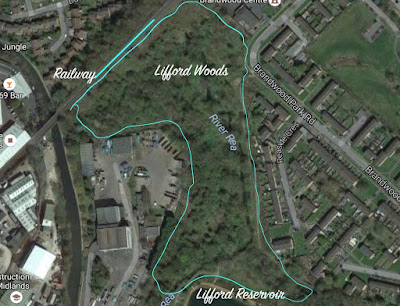
Lifford Woods An area of land bordering the River Rea at Allens Croft, with a pathway to Lifford Reservoir and Lifford Hall. The linear woodland runs either side of the river with willows and alders thriving. The site is little used today, with most people passing along the walkway, whilst much of the area is out of the public domain, cut off by railway embankment and the river. In terms of wildlife, I guess this is under recorded, as are most sites, all records should be submitted to EcoRecord and twitter is a good way of doing this. Lifford Woods and surrounds The account below is taken from "Lifford - William Dargue - A History of BIRMINGHAM Places & Placenames" B30 - Grid reference SP055796 la Ford: first record 1250 Lifford stands close to the ford across the River Rea. As the red clay on the east side of Birmingham became slimy and slippery in wet weather, a place where the river ran over a firmer bed would have been a draw ...
Fir at Cannon Hill Park possibly Abies grandis Winter 'evergreens', a suitable and seasonal distraction in terms of identification, providing a rather more challenging activity than the now fallen broad leaves, although having said that, a tree with no leaves is just as challenging when only buds and bark are at play. Also, the language of evergreens is somewhat different to that of broadleaves, in both biological terminology and description, providing a continual monologue through the year, with a voice that changes less hysterically than its broadleaf distant relatives. The other challenging difficulty of course is the weather, standing with a field guide and key on a cold day is not everyone's idea of fun. The subject trees related to in this passage are mainly those found locally either at the Cannon Hill Park Tree Trail or at the Highbury Park Pinetum and Highbury Estate. All of the trees have been introduced with various planting schemes over the past 80 years or so,...
Boer War Memorial Sculpture Cannon Hill Park The 'memorial statue' has become the subject of contention over the past few years, as the rewriting of history, providing us with alternative details of a particular event, gathers pace. Edward Colston in Bristol Robert Milligan at West India Dock Quay Cecil Rhodes at Oriel College, Oxford To name a few- Most, if not all statues of this kind represent either an occasion or an individual for actions deemed celebratory in their day, yet as successive generations awaken to further revelations, the discussions can take a turn in another direction, and we begin to question other aspects and related facts. A broader section of our previously unvoiced society is able to voice opinions according to a different perspective. https://www.historyandpolicy.org/opinion-articles/articles/the-fall-of-slavery-statues-symbols-and-social-contention The article - ' The fall of slavery: statues, symbols and social contention' - ...




Comments
Post a Comment